
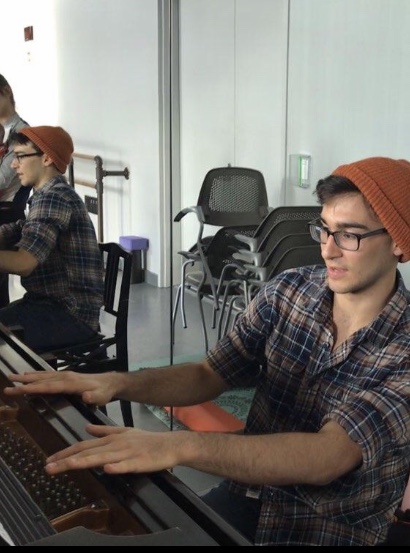
Cameron Thomas, from Rochester, NY, is a professional dancer with Kansas City Ballet. He started his ballet training at Rochester City Ballet before moving to NYC by himself at the age of 17 to further his training at American Ballet Theatre’s Jacqueline Kennedy Onassis School. Cameron’s artistic prowess is not limited solely to dance, however; he is also a talented pianist and accompanist!
1. To get off to an unconventional start, please write a haiku that describes what dancing feels like to you.
When I can not speak
I will try to understand
Now I am alive
2. How did you get into dancing? How did you become a professional dancer?
I started dancing when I was eleven years old in my hometown of Rochester, NY. After trying many different sports and being pretty bad at all of them, I followed my sister into gymnastics. Before long, I found the mandatory ballet class we took once a week to be the highlight for me. I was and am still profoundly lucky to have supportive parents of me in whatever I do. They recognized my excitement, and I found my way into the Rochester City Ballet’s production of The Nutcracker that year. As is the case for so many young dancers, I fell hard for the stage. It was the spark for me. I looked up to the professionals in the company, and I worked well with patient, experienced teachers. I continued my training there until, on a whim, I auditioned for American Ballet Theatre’s JKO School, where Franco De Vita allowed me to train. That was when my mind was made up, and I wholeheartedly threw myself into dance. After a lengthy audition season in spring 2015, I found my first opportunity in the professional world at Kansas City Ballet. In the fall, I will be returning for a fifth season there!
3. Did dancing help you through anything difficult in your life?
I could make a case for dance helping me through everything in my life. Nothing specific comes to mind, but dance has taught me how to truly push myself to be better. It lends a focus and structure that grounds me. As is the case with any serious discipline, there is a ritualism to the pursuit of improvement that helps me stay motivated in every aspect of my life. As I have gotten older and begun working on repertoire that is more physically and emotionally involved, I find that dance constantly challenges what I am capable of doing and who I am capable of being. This lifestyle demands creative thinking and hard work. These qualities help me in everything that I do, and I certainly hope I am better for it.
4. What adversities have you had to overcome to continue pursuing your profession?
To be honest, I have had a relatively lucky experience with dance throughout my life. I had supportive parents, good teachers, and plenty of opportunity. I would argue my path to being a professional was serendipitous. I do work extremely hard and have faced my share of rejection, but I don’t think I would be comfortable claiming that I have overcome major adversity in comparison to many of my fellow artists working today. If anything at all, I would say I am not the most physically gifted dancer. I have had to find ways to adjust my technique to work within those boundaries, and that has made me more thoughtful about how I approach movement. We all work with what we have!
5. Tell us your funniest story about the dance world.
I don’t know if it’s particularly funny, but I have definitely been laughed at for it plenty of times… I was playing Drosselmeier for the first time in Kansas City Ballet’s The Nutcracker. Like in most Nutcracker productions, it is a character role with lots of detail and a terrifying amount of interaction with finicky props onstage. I had one dress rehearsal to prepare for my first show, which was a student matinee. I knew the role, but the prop gods were not with me. Our nutcracker prop in the party scene has a detachable head, so Fritz can break the toy at the end of the party. As I revealed the nutcracker to the audience, I was way too excited and flung him forward, popping his head off. It rolled right down center at full speed, covered half the stage, and rolled into the pit. If I were bowling, it would have been a strike. I hope I covered my mistake well (I really didn’t at all), but the only thing I remember is loud laughs and jeers coming from the young kids in the audience and louder laughs and choice words from the dancers onstage. At least Clara still seemed pretty happy with her headless nutcracker.
6. What would you say to someone who is hesitant to go see a ballet performance?
This is a difficult question to answer. What I think is most important for an audience member to understand is that dance is an active medium of art. In order to fully appreciate most great choreography, it is usually necessary to invest some amount of time and energy looking into why the work is beautiful. Context makes an absolute world of difference. A classic might shine in its purity and technical precision, while new choreography might seek to creatively challenge the form. Some works flaunt the dancers’ athleticism, others highlight their delicacy, others still display their ability to connect with an audience emotionally. To appreciate a work for what it does best, I would say be ready to engage with the work and with the performers- to watch and listen actively, think critically and inquisitively, be observant, try to make connections, and be prepared with some background knowledge of the circumstances under which the piece was created. Not every work is for everyone, but if each performance is judged in the context of what it is trying to be or what it wants to say, then I think there is so much to love about the vast majority of dance being performed around the world for every audience member. Basically, if you do nothing else, please read the program. It will help a lot.
7. If you had only one sentence to convince someone of the importance of the arts, what would you say?
That’s a big responsibility so I might just throw it to Oscar Wilde:
“It is through art, and only through art, that we realise our perfection”
8. If ballet had a slogan, what would it be? Or if you had a slogan, what would it be?
A good friend of mine says that he tries to simply, “Show up every day and get better.” I strive to dance that way, and I hope I am able to live that way.
Edited by Adelaide Clauss
 Dancers Are